

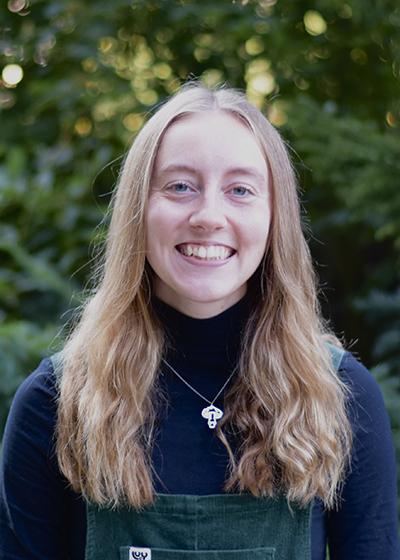
Lily Houtman
My name is Lily Houtman, and I am a PhD Candidate in Geography at Penn State University. My research falls primarily within the subfield of cartography, and also incorporates aspects of human geography. My primary research, funded by a National Science Foundation (NSF) Graduate Research Program Fellowship (GRFP), focuses on studying mobile thematic map design. My Master’s research, also conducted at Penn State, studied how news cartographers and data journalists design mobile news maps. A primary result of this research was that data journalists assume audiences consume the news very quickly on mobile devices, and that they do not want to spend a lot of time using interactive maps. Additionally, they assume their audience leans older, as well as more white and more male. However, it is difficult to test their assumptions, given that they have very limited time for user testing.
My PhD research builds on my Master’s research. I am conducting a literature review on mobile thematic map design under the guidance of my advisor, Dr. Anthony Robinson, and my committee member, Dr. Cynthia Brewer. My second chapter focuses on how young adult audiences use mobile thematic maps in the news, seeking to answer some of the questions brought up by data journalists in my previous research. This work is also influenced by my other committee members: Dr. Mark Ortiz, who studies youth geographies, and Dr. Pamela VanHaitsma (Communication Arts and Sciences), who studies rhetoric and archives. My third chapter focuses on the design of a digital interactive map about petrochemicals and fracking for community members in southwestern Pennsylvania, in collaboration with Dr. Jenn Baka.
Beyond my dissertation research, I have also sought to apply feminist, queer, and trans theory to cartography. In collaboration with Dr. Dana Cuomo (Lafayette College), I developed maps which share experiences of gender-based violence on Lafayette’s campus, using design techniques which anonymize individual experiences while still showing areas where many students experience harm. These maps were used to argue for changes to the built environment on campus. Additionally, I am working with Dr. Melissa Wright to develop non-binary maps of the Mexico-U.S. borderlands and Rio Grande River Valley. These maps seek to critique traditional binary representations of nation-state borders, while also recognizing that these borders impact the lived experiences of many humans and non-humans from the region.
Before attending Penn State, I received a B.S. in cartography/GIS from the University of Wisconsin-Madison. There, I conducted a senior honors thesis titled "Mapping Presidential Elections: An Empirical Analysis of Effective Design Techniques." I also worked as a map production assistant for the UW Cartography Lab.
In addition to my academic research, I am involved in many service roles to my department and the discipline of geography. Within Penn State Geography, I am a member of the Coffee Hour (Colloquium) Committee, inviting external and internal speakers to the department. I am also the President of Supporting Women in Geography (SWIG), a graduate student organization focused on supporting gender minorities in geography. Within the College of Earth and Mineral Sciences (EMS), I have also volunteered as a peer mentor for EMS students who are applying to the GRFP. Beyond Penn State, I serve as a member of the American Association of Geographers (AAG) Justice, Equity, Diversity, and Inclusion (JEDI) Committee. I was also elected to be one of the Directors-At-Large for the North American Cartographic Information Society (NACIS). In this role, I manage the NACIS Shop which sells conference merchandise, am part of the DEI committee and organized the 2025 DEI Speaker Series on Feminist Cartography, and have hosted the first day of the conference, Practical Cartography Day (PCD).
I am also a member of the GeoGraphics Lab at Penn State, where I assist with cartographic design projects. As a graduate student in the lab, many of the projects I work on combine both cartographic design and academic research. Additionally, I frequently serve as a mentor to the undergraduate students in the lab.

